
TUNING FORK:
From Wikipedia, the free encyclopedia
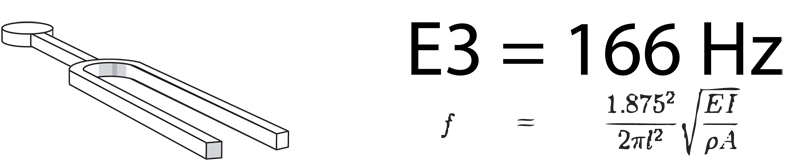
A tuning fork is an acoustic resonator in the form of a two-pronged fork with the prongs (tines) formed from a U-shaped bar of elastic metal (usually steel). It resonates at a specific constant pitch when set vibrating by striking it against a surface or with an object, and emits a pure musical tone after waiting a moment to allow some high overtones to die out. The pitch that a particular tuning fork generates depends on the length of the two prongs. Its main use is as a standard of pitch to tune other musical instruments.
The tuning fork was invented in 1711 by British musician John Shore, Sergeant Trumpeter and Lutenist to the court, who had parts specifically written for him by both George Frideric Handel and Henry Purcell.
The main reason for using the fork shape is that, unlike many other types of resonators, it produces a very pure tone, with most of the vibrational energy at the fundamental frequency, and little at the overtones (harmonics). The reason for this is that the frequency of the first overtone is about 52/22 = 25/4 = 6¼ times the fundamental (about 2½ octaves above it). By comparison, the first overtone of a vibrating string or metal bar is only one octave above the fundamental. So when the fork is struck, little of the energy goes into the overtone modes; they also die out correspondingly faster, leaving the fundamental. It is easier to tune other instruments with this pure tone.
The frequency of a tuning fork depends on its dimensions and the material from which it is made:
Where:
f is the frequency the fork vibrates at in Hertz.
1.875 the smallest positive solution of cos(x)cosh(x) = -1.
l is the length of the prongs in metres.
E is the Young's modulus of the material the fork is made from in pascals.
I is the second moment of area of the cross-section in metres to the fourth power.
? is the density of the material the fork is made from in kilogrammes per cubic metre.
A is the cross-sectional area of the prongs (tines) in square metres.
The ratio in the equation above can be rewritten as r2 / 4 if the prongs are cylindrical of radius r, and a2 / 12 if the they have rectangular cross-section of with a along the direction of motion.
